
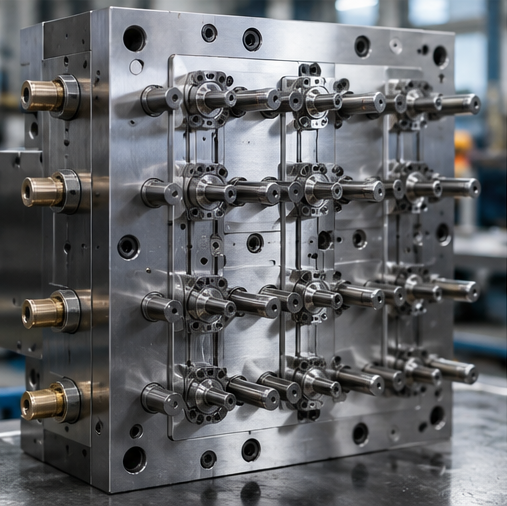
When manufacturers look to improve injection mould performance, attention is often placed on areas such as cycle times, cavity design and production output. However, one of the most influential factors in mould performance is often less visible: cooling efficiency.
Cooling plays a critical role throughout the moulding process and can directly influence production speed, component quality and overall operational efficiency. Poor cooling performance may increase cycle times, affect consistency and reduce productivity, while well designed cooling systems can help manufacturers improve output and maintain reliable production.
This guide explores why cooling efficiency matters and the role it plays in injection mould tooling performance.
Why Cooling Matters in Injection Moulding
Injection moulding follows a cycle consisting of:
- Injection
- Packing
- Cooling
- Opening
- Ejection
Of these stages, cooling often accounts for the largest proportion of overall cycle time. This means cooling performance can have a significant influence on productivity. Even small improvements may create measurable gains across long production runs. For high volume manufacturing environments, these gains can become substantial.
How Cooling Affects Cycle Time
Cycle time remains one of the most important measurements within injection mould manufacturing.
Shorter cycles may support:
- Increased output
- Better machine utilisation
- Improved efficiency
- Reduced production costs
Cooling efficiency directly affects how quickly components can move through production. If heat removal is slow or inconsistent, cycle times often increase. This can limit productivity.
Supporting Consistent Component Quality
Cooling influences more than speed. It also affects component quality.
Uneven cooling may contribute to issues such as:
- Warping
- Dimensional variation
- Surface defects
- Internal stress
- Reduced repeatability
Consistent thermal management helps support stable production conditions. For precision environments, this becomes increasingly important.
Cooling Efficiency and Dimensional Stability
Many injection moulded components require strict dimensional control.
This is especially relevant within sectors such as:
- Medical manufacturing
- Packaging
- Consumer products
- High speed production environments
Variations caused by inconsistent cooling may affect:
- Assembly performance
- Product quality
- Production reliability
Efficient cooling systems help improve dimensional consistency across production runs.
The Role of Tool Design
Cooling performance begins at the design stage.
Tool engineering may consider factors including:
- Cooling channel placement
- Thermal distribution
- Cavity arrangement
- Heat removal efficiency
- Material flow characteristics
Good design supports balanced temperature control throughout the mould. Poor thermal management can create hotspots and inefficiencies.
Cooling and Fast Cycling Tool Performance
Fast cycling injection mould tools rely heavily on efficient cooling. As manufacturers seek shorter production cycles, cooling performance becomes increasingly important.
Efficient heat removal may help:
- Reduce cycle duration
- Increase output
- Improve repeatability
- Support stable operation
Without effective cooling, faster production targets may become difficult to achieve.
Cooling Efficiency Supports Long Term Production Performance
Tooling investments are often expected to support production over many years.
Efficient cooling contributes to long term performance by helping maintain:
- Stable production
- Consistent quality
- Predictable output
- Operational efficiency
Improving cooling efficiency is therefore not only about immediate gains. It also supports future manufacturing performance.
Reviewing Existing Tool Performance
Manufacturers reviewing tooling efficiency may wish to consider:
Are cycle times increasing?
Are there signs of dimensional variation?
Is output lower than expected?
Have maintenance requirements increased?
These questions may help identify areas where cooling performance should be reviewed.
Manufacturing Efficiency Continues to Evolve
Modern manufacturing increasingly focuses on:
- Efficiency
- Automation
- Reduced waste
- Higher output
- Precision engineering
Cooling performance supports all of these objectives. As production demands continue increasing, thermal management will remain an important part of injection mould tooling strategy.
Precision Tooling Support from Metalite
At Metalite, we support manufacturers with precision engineering and injection mould tooling solutions designed around performance, accuracy and long term reliability.
Our experience includes tooling applications where efficiency, repeatability and manufacturing performance are essential.
Whether reviewing tooling strategies or supporting future production requirements, our team can help deliver precision focused solutions. Get in touch with us today to learn more.