
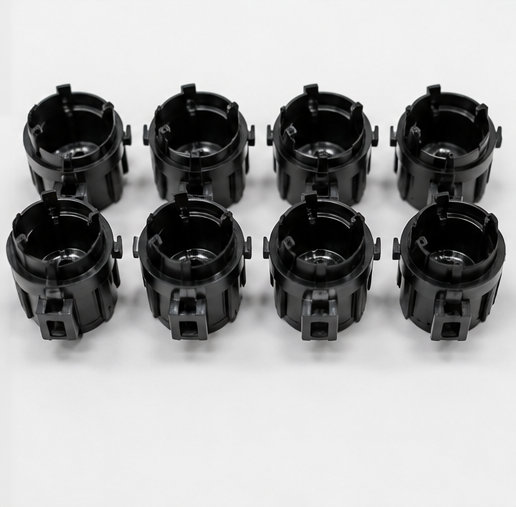
Production efficiency remains one of the biggest priorities in modern manufacturing. As demand increases and production targets become more challenging, manufacturers are continually looking for ways to improve output while maintaining quality and consistency. Fast cycling injection mould tools play an important role in achieving this.
By helping reduce cycle times and improve production efficiency, these tooling solutions support manufacturers operating within high volume environments where performance and reliability are critical.
This guide explores what fast cycling mould tools are, how they work and why they are increasingly important in modern manufacturing.
What Are Fast Cycling Injection Mould Tools?
Fast cycling injection mould tools are designed to support shorter production cycles while maintaining consistent quality. The aim is to reduce the time required to complete each moulding cycle without compromising component integrity.
A standard moulding cycle typically includes:
- Injection
- Cooling
- Opening
- Ejection
- Resetting
Fast cycling tooling focuses on optimising these stages to improve overall production speed. Even small reductions in cycle time can create significant gains across large production volumes.
Why Cycle Time Matters
Cycle time has a direct influence on manufacturing output.
Reducing cycle time may help manufacturers:
- Increase production capacity
- Improve operational efficiency
- Lower production costs
- Maximise equipment utilisation
For example, reducing a cycle by only a few seconds may result in thousands of additional components over extended production runs. This is particularly valuable within high volume industries.
Industries That Benefit from Fast Cycling Tooling
Fast cycling mould tools are often used in sectors where large volumes and repeatability are essential.
Examples include:
- Packaging
- Medical manufacturing
- Consumer products
- Caps and closures
- Thin wall packaging applications
These industries frequently require high throughput while maintaining strict quality standards.
How Fast Cycling Tools Improve Efficiency
Several factors influence cycle performance.
Optimised Cooling Systems
Cooling efficiency is one of the most important factors affecting mould cycle times. Poor heat management may increase cooling periods and reduce productivity.
Well designed cooling systems help:
- Remove heat efficiently
- Improve consistency
- Reduce cycle duration
- Support dimensional stability
Cooling performance often becomes increasingly important in high output environments.
Tool Design and Flow Efficiency
Fast cycling tools require careful engineering.
Considerations may include:
- Material flow paths
- Gate positioning
- Cavity layout
- Venting
- Thermal control
Efficient flow design supports faster processing while helping maintain part quality.
Precision Manufacturing
Tool accuracy remains essential.
Precision engineering helps ensure:
- Repeatability
- Component consistency
- Reduced variation
- Reliable operation
Small tooling inaccuracies may affect cycle efficiency and production performance.
Balancing Speed with Quality
Increasing output should never come at the expense of quality.
Fast cycling mould tools must maintain:
- Dimensional accuracy
- Surface finish quality
- Repeatability
- Product integrity
The objective is not simply faster production. It is achieving faster production while maintaining standards. Successful tooling strategies balance efficiency with reliability.
Supporting High Volume Manufacturing
Fast cycling tooling is particularly valuable where manufacturers need to maintain continuous production.
Benefits may include:
- Increased output
- Reduced downtime
- Improved efficiency
- Better production planning
- Greater operational flexibility
As manufacturing demands continue growing, efficient tooling becomes increasingly important.
Fast Cycling Tools and Long Term Production Planning
Tooling decisions often influence manufacturing performance for years.
Investing in efficient mould design may support:
- Future capacity requirements
- Production growth
- Reduced operational costs
- Improved competitiveness
For businesses planning long term production, tooling efficiency becomes a strategic consideration rather than simply an engineering decision.
The Future of Injection Mould Efficiency
Manufacturing continues moving towards greater efficiency, automation and optimisation. Fast cycling injection mould tools support this direction by helping manufacturers improve productivity while maintaining quality. As output demands increase, tooling performance will continue playing a major role in production success.
Precision Injection Tooling Support from Metalite
At Metalite, we support manufacturers with precision engineering and injection mould tooling solutions designed for demanding production environments. Our experience
includes tooling applications where performance, efficiency and repeatability are essential.
Whether supporting high volume manufacturing or reviewing tooling strategies, our team can help deliver precision focused solutions. Get in touch with our team today to learn more.