
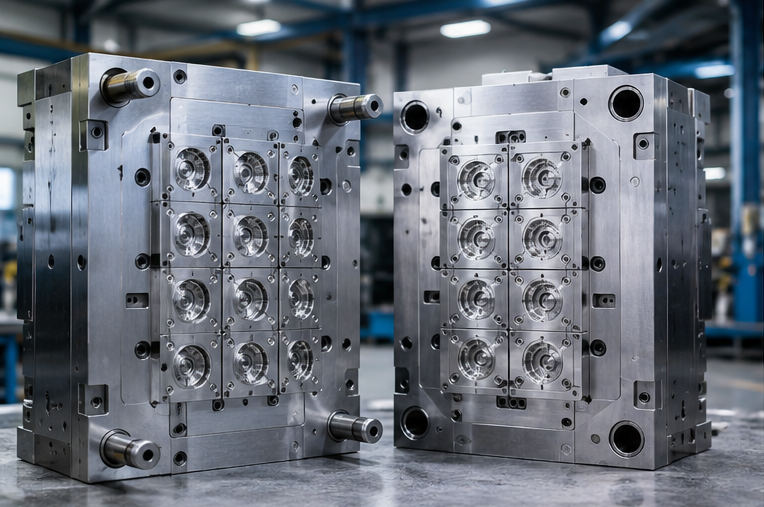
Multi cavity tooling plays an important role in modern injection mould manufacturing. As production demands increase and manufacturers look to improve efficiency, reduce unit costs and increase output, multi cavity mould tools are often considered as part of long term production planning.
However, multi cavity tooling is not always the right solution for every project. Understanding when it makes sense and how it supports manufacturing performance can help businesses make more informed tooling decisions.
This guide explores what multi cavity tooling is, how it works and where it may be most beneficial.
What Is Multi Cavity Tooling?
A multi cavity injection mould tool is designed to produce more than one component during each moulding cycle. Instead of creating a single part per cycle, multiple identical parts are produced simultaneously within the same tool.
For example:
- Single cavity tool = one component per cycle
- Four cavity tool = four components per cycle
- Eight cavity tool = eight components per cycle
Higher cavity counts are also possible depending on component design, production requirements and tooling strategy. The objective is simple: increase output while improving manufacturing efficiency.
Why Manufacturers Use Multi Cavity Tooling
Production environments are continually looking for ways to improve productivity. Multi cavity tooling offers several advantages that support this goal.
Increased Production Output
The most obvious benefit is higher production volume. Producing multiple parts during each cycle allows manufacturers to significantly increase output without increasing machine cycles.
This can be especially valuable in:
- Packaging production
- Medical manufacturing
- Consumer products
- Caps and closures
- High volume moulding applications
Where demand is high, multi cavity tooling can help maintain productivity.
Reduced Cost Per Component
Although multi cavity tools often require greater initial investment, they may reduce overall production costs over time.
Benefits can include:
- Lower labour requirements
- Reduced machine time per component
- Improved production efficiency
- Increased throughput
For high volume projects, this can create long term operational savings.
Improved Manufacturing Efficiency
Multi cavity tooling supports more efficient use of production equipment. Instead of running multiple single cavity cycles, manufacturers can achieve greater output from the same process.
This may help improve:
- Production scheduling
- Capacity planning
- Manufacturing efficiency
- Resource utilisation
- When Does Multi Cavity Tooling Make Sense?
Not every project requires multi cavity tooling. Several factors influence whether it is appropriate.
High Volume Production
Multi cavity tools are generally best suited to larger production volumes. Businesses producing significant quantities often benefit most from increased output.
Typical examples include:
- Packaging components
- Medical products
- Consumer goods
- Repetitive moulded parts
Lower volume projects may not always justify higher tooling complexity.
Stable Product Designs
Tooling investment is often easier to justify when component designs are established. Frequent design changes may increase costs and complexity.
Multi cavity solutions generally work best where:
- Product designs are finalised
- Production demand is predictable
- Long term manufacturing is planned
Consistent Demand
Multi cavity tooling often supports products with ongoing production requirements. Where demand remains stable, increased output capability becomes more valuable.
Tool Design Considerations
Multi cavity tools require careful engineering and planning.
Factors may include:
- Material flow balance
- Cooling performance
- Cavity layout
- Cycle efficiency
- Component consistency
Maintaining repeatability across every cavity is essential. Even small variations may affect component quality or production performance. This is why precision engineering remains critical throughout the tooling process.
The Role of Cooling in Multi Cavity Tooling
Cooling efficiency has a major influence on mould performance.
Well designed cooling systems may help:
- Reduce cycle times
- Improve consistency
- Support dimensional stability
- Increase output efficiency
As cavity counts increase, cooling design often becomes even more important. Efficient heat management supports reliable production.
Multi Cavity Tooling and Modern Manufacturing
As manufacturers continue seeking greater efficiency, multi cavity tooling remains an important strategy.
It helps businesses:
- Increase production output
- Improve manufacturing efficiency
- Reduce unit costs
- Support long term growth
For high volume environments, it can provide significant operational advantages. However, successful implementation depends on good design, precision engineering and understanding production requirements.
Injection Mould Tooling Support from Metalite
At Metalite, we support manufacturers with precision engineering and injection mould tooling solutions designed around performance, efficiency and reliability. Our experience includes tooling applications for demanding manufacturing environments where accuracy and repeatability are essential.
Whether planning new tooling projects or reviewing production strategies, our team can help support your requirements. Get in touch with us today to learn more.